Showing posts with label Tools of the Trade. Show all posts

Tuesday, May 20, 2014

The Red Shirts Are Coming

I did not make the finals in the Palm Street Film’s contest.  I was not surprised and I’m not especially upset about it, they had a very specific purpose in hosting the contest so I knew it was going to be even more subjective than usual and it’s one I entered on a whim rather than by strategy.

And there’s the whole “rejection is a part of writing” thing.  I’m much more interested in the Charlottesville contest.  And now that CWA has extended their deadline I’m wondering if I should give it a go.  They offer coverage like BlueCat which is good, but it’s a very pricey entry.  And then there’s Austin.  Next year for Austin.

Today I’d like to take another look at jargon.  I’ve been reading Daphne’s book about writing and in it she cautions against using jargon in your writing.  “It’s not clear in many cases.  You are being presumptuous about your readers.”  That’s not bad advice.  But jargon exists for a reason and if you are communicating with a peer group instead of writing an article for a mass market publication, it’s very efficient use of your writing space and audience attention span.

To wit, yesterday I was part of a discussion that centered on needing “a fifth man” but not “wanting to add a character.”  Early in someone suggested using a “red shirt” which was brilliant.  We all knew exactly what was being talked about and it met the requirements.  Jargon.


What is a red shirt?  Why he’s the member of the boarding party that doesn’t get beamed back to the ship.  Because he’s vaporized/transformed/eaten by a giant spider-fly-amoeba-plant/fallen in love with an alien.  From Star Trek.

Tuesday, April 15, 2014

"Don't blink."


I’m really liking this new ultrabook vs. the iPad for writing.  Being able to work directly in Final Draft and Word is nice.  Being able to use Power Structure on the go is very nice.  Being able to use them all at once is… slow.  It works, but I think the machine that was twice the price would handle it better.  When I am writing in FD but fast switching back and forth with PS for reference, I can end up a couple of sentences ahead of the application.  There’s a good buffer so as long as I’m accurate it isn’t that big of a deal, but it does slow things down.

I type quickly, but not that quickly.  Unless you hunt and peck you’ll have the same issues if you do what I did and buy the cheapest, smallest machine you could find.  The one that was twice the price probably doesn’t have the same issue.  In the old days I’d worry about battery life with the faster processor but it advertised 8 hours.  That’s impressive.  I’m impressed with the 5-6 I’ve been getting from this one.

The good news is that I don’t have any issues at all running a single application and that usually how I roll.  The really good news is that my concerns over the larger footprint are completely unfounded.  I didn’t think an extra inch LxW would be that big of a deal but I didn’t expect it to actually be better!  This little computer is far more stable on my lap than the iPad was.

That’s very convenient when you are switching to a siding to go around a broken down freight train.


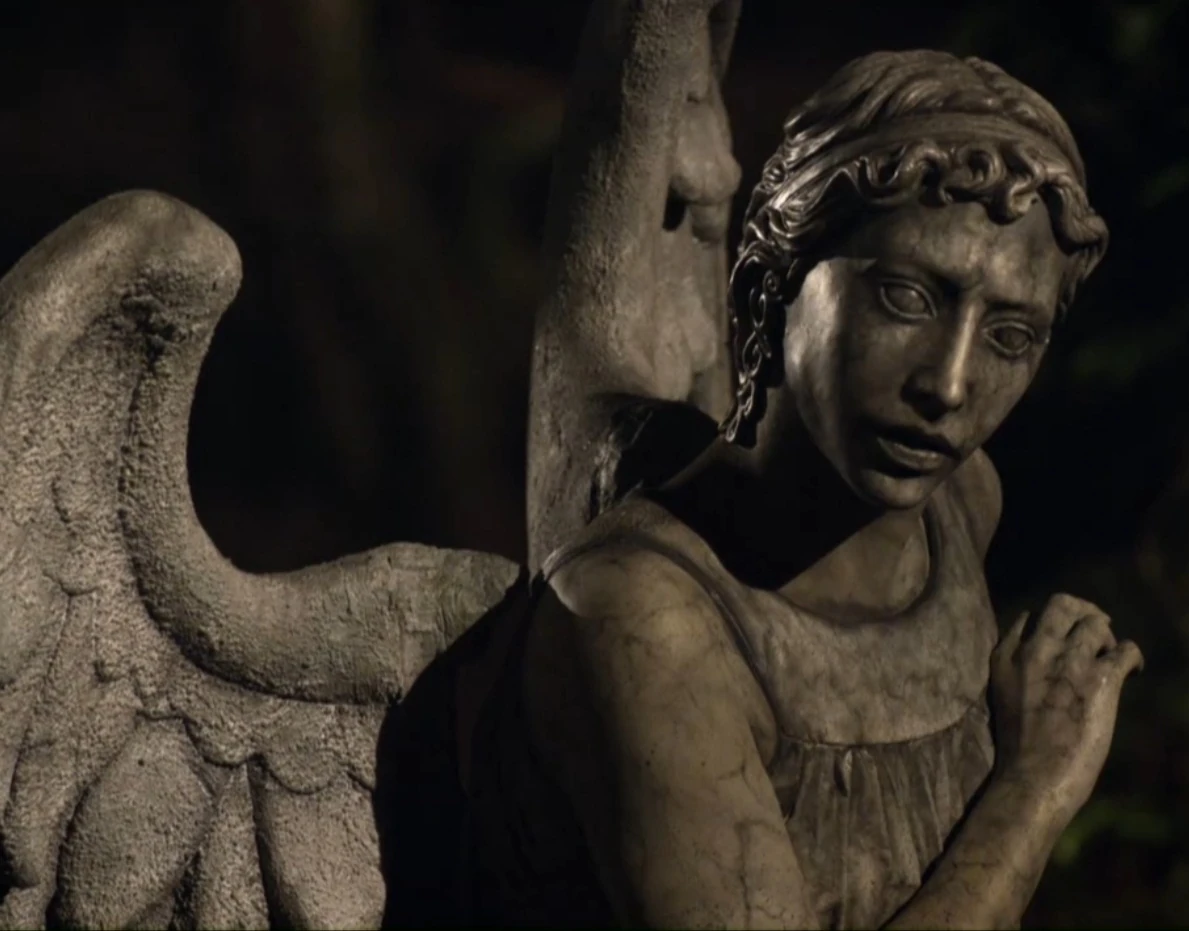
Completely unrelated, I watched the “Weeping Angels” episode of Dr. Who last night and I have looked over my shoulder about six times while writing this post.  It’s been a long time since TV has made me jumpy.  Maybe I should cut back on the coffee.  I absolutely love how the show runners are able to switch between laugh out loud silly and pull the covers over your eyes scary using the same premise and characters.  Brilliant.


Tuesday, March 18, 2014

I think the word you're searching for is "Space Ranger"

How many tricks does your pony have?  One?  Two?  Infinity?  My wife an I played a game with our children as they were growing up about who loved who more.  They usually ended at infinity times infinity to the infinity power.  (And Mrs. Hooper said I'd never use imaginary numbers...)  That's how many tricks your pony needs if you want to stay with something creative -- job, hobby, whatever.

Okay, so infinity times infinity to the infinity power isn't actually an imaginary number -- just a silly number -- but the point is still important.  A one trick pony won't get you very far.  Maybe that's enough for you but somehow I don't think so.  I think settling for one trick is subtle way to quit.

Speaking of one trick, the only imaginary number I can remember from 9th grade is "the negative radical."  "You can write it," said Mrs. Hooper, "But you can't ever get to it."  Maybe for a mathematician.  But I'm an author with the power to create reality.  I can take you to infinity... and beyond.

Tuesday, March 11, 2014

Who are you writing for?

John Steinbeck gave us 6 "rules" for writing.  I've read them several times in different places but there's a difference between knowing something and knowing it.  Yesterday I read them again.  I can't remember all six.  In fact, I can only remember 1.  Probably because I've heard variations on the other 5 so many times that it all sort of runs together.

That rule I remember?  Forget about your audience.  It doesn't exist.  Reading is a solitary action and everyone has a different experience.  So pick one person and write for that person.   Just that person.

I've got a short story going that was struggling from trying to sound literary.  How silly.  It needs to sound like me telling a story to someone.  Someone specific.

Steven King wrote about this in his book -- I have a tickling memory that he actually quoted Steinbeck -- and added the concept of "first reader."  You don't have to write for your first reader, but you need to write for one person.  Even if that person isn't someone you know, or someone who is even alive.  It will keep your story focused.

I remember another of his rules -- always say your dialogue aloud -- but I'd forgotten because I've always done that.  I hope you have too.

Tuesday, March 4, 2014

Jeffrey Jacob the jet plane

I’m really digging the new digs.  Okay, not exactly new digs, but a total rearrangement of my writing space.  Studio.  The fold top desk, the hanging herons, the hot tamales dispenser… it works.

What I’m not digging is the realization that I do actually have to have an outline to write a coherent story of any length.  Apparently I’m not one of the .000003% who can fake it.  Fortunately, that realization came with an understanding of why I need to outline.

Random.  More specifically, to not be random.  I can write all day long adding things that “could be this or that.”  Without an outline I rarely deliver on the promise (potential) and I end up with just a bunch of things loosely drawn together by a main character or two.  Sort of like a J.J. Abrams TV show.

The brilliant script I’d reached Fade Out on just days ago proved it – my first reader went through it and said, “This is not what you said it would be.  And there are huge holes in it.”  She was right.  I’d strayed and skipped.  That’s fine if your name is Alice or Pollyanna, but not if you’re trying to write the next “Usual Suspects” or “Training Day.”

So I dove into my new outlining/organizing app and started working.  It’s a lot of work, working.  I realized how much I didn’t know about my story and characters.  So I looked for a distraction and found it in a contest.  I wrote 13 pages in a different story and said, “Hey – what do you think of this?”

She said, “I think you need to finish something.”  I do.  But not just finish, finish it well.  Those 13 pages were filled with promises, a bit of humor, and a story --- though not a complete story.  Except for the main character, it was just a lot of “he could be this, she could be that” and a few random events that moved the feeling along, but not a coherent plot.

That was the epiphany.  It’s not just about competent writing with a few hooks.  It’s about telling a story.  A story that must be told.  A story you absolutely want to hear/see/read.


So I’m outlining.  I’m plotting.  I’m tracking the rising and falling conflict of my subplots.  I’m “breaking” the story which is what I should have done before I ever typed fade in.

Tuesday, February 25, 2014

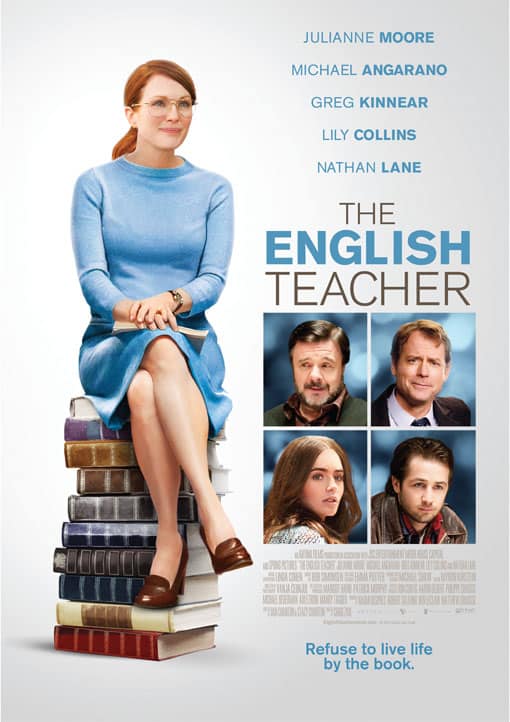
"I had my heart set on becoming an English teacher,..."

Oh, the importance of routine.  I was ahead of schedule today.  By quite a lot.  Then I broke the routine and left the house a bit later than usual.  Hit a different traffic pattern.  Missed my train.  Which is to say that I beat the train to the station but had to park too far away to get across the tracks before it arrived.

I am not one to race with trains, climb under or around them when not engaged in my official duties, or stress about missing one when there's another about half-an-hour after.  (That's an interesting construction -- is it legal?)


One of the routines I am currently engaged in is checking the blog "Daily Writing Tips" (http://www.dailywritingtips.com/) during lunch break while I eat my peanut butter and love sandwich.  It's a great source of information about how to use the English language correctly.  I find it to be to the point, filled with all of the examples I ever need in a format that's easy to skip over if I don't need them.  The topics are varied but applicable.  I've actually learned somethings.

And forgotten them.  Which is why I check every day...

Tuesday, February 18, 2014

"Don't write about the weather. Ever."

*** R&A has exceeded 8000 page views.  Thank you!

Elmore Leonard is going to roll over in his grave at this, but I just can't resist commenting on the weather this morning.  The sun is brilliant, there's a dusting of snow, and the roads are slick with ice.  Nothing special there, I know, but by this afternoon we'll have picked up 30 degrees and gone from below normal to above normal.  A dramatic change like that, with the climax providing such a wonderfully warm feeling and foreshadowing the season to come is like the best of stories.

I'm pondering the writing process this morning – specifically the outline.  As longtime readers know, I'm a huge fan of The Blackboard online community.  Recently I’ve noticed a huge difference in the way that writers work.  Some won't write the first word until they've detailed the entire story.  Others won't do more than sketch a rough map of the plot that their characters will follow.

I never used to outline.  If a story took more than a few thousand words I either didn't finish it because I didn't know where it was going or didn't finish it because it was a rambling mess.  I wrote a few months ago about how much I thought outlining was a good idea now, and how using index cards was, in point of fact, one of the best ideas out there.

Now that I've been writing seriously every day for a year, I'm not so sure that outlining is the cat's meow.  This is to say that I think you must write longer stories (screenplays and novels) with a plan, but you don’t necessarily want to be burdened with every detail.  I can see how that really does stifle creativity.  For this most recent story I didn't plot it out with index cards.  I wrote the treatment and then used that as an outline for the first draft.

I worry that for many writers the in-depth outline is a crutch to keep from starting.  For others it's the desire to minimize rewrites by making the first draft better.  There's also the folks who do it because they think they must.

So what is the outline really?  For me it's the original plan of how to get from A to B including snippets of dialogue and characterization.  It isn't I.A.1.a or 40 index cards divided into 4 sections.

I've just started using a new program that I refer to as "my creative secretary" -- spotting holes, dangling characters, and where the story arcs fall flat.  (I'll review it once I've finished a project with it -- I hate the summary judgments by people who test the features but not the application.)

It should help me write a tighter, more exciting, and entertaining tale.  But it still has to be me writing it, structure alone is boring.

Tuesday, February 11, 2014

"It's not as bad as it looks."

Watched a couple of basketball games last night.  (You may have caught the tweet about one ref explaining the rules to the other ref...)  It was a double header -- sort of -- #3 and #4 both had games, fortunately at the same place and in succession.

                My wife and I were struck by the differences between the two games.  Specifically, the size and skill of the boys playing.  There was only one grade between them but the contrast between the older and younger players was astounding.

                First, the boys were all much bigger.  They were stronger, faster, and more coordinated.  Second, they demonstrated better ball handling -- some were better than others, but at this next level, they all had the basics.

                I suspect that those boys on the older team don't realize how much better they've gotten.  Or how much they’ve grown.  The change occurred too slowly to notice themselves.  But in one year all of that little growing has added up.

                A lot can happen in a year, even if it's only a page or two each day.  (See how I slipped in a bit about writing?)  Breakthroughs are great, but you can’t count on them.  What you can count on is enhancement.  Slow, steady progress toward mastery.

Tuesday, January 28, 2014

Write around the block

There is writer's block.  But it's a choice.  You may be blocked on a specific project, just can't figure it out, and that's got to be hard.  But it shouldn't block your writing altogether.  Write something else for a season.

Or perhaps you have something specific to write about but you just can't get it together.  No worries, Mate.  Write it all falling apart.  Then start it again.  And again if you must.  Just keep putting it down.  Your body knows how to write.  Your brain knows it has to write.  Get yourself rolling down the hill, pop the clutch, and you'll be off to the races before you know it.

It's sort of like running in that the first half mile or so always makes you want to throw-up but then, once your brain discovers that you are more stubborn, and you are doing this, it stops complaining, stops making excuses, stops teasing you with chocolate glazed donuts, and gets down to the business of pounding out miles.  Or words.

If you're afraid of the blank page put a word on it.  Then it isn't blank.  If it's the wrong word you can change it.  You know how to do that.  And you know to try a different word.  Trust yourself.

It will come.

Tuesday, January 21, 2014

"Where's the snow?"

Tuesday.  And my office is closed because it will start snowing at any minute.  Any minute now.  Snow.  Momentarily.  Keep your eyes peeled.  It’s about to start.  The snow.  Any second.
While we wait, let me catch you up on this week.  This is the last week of minority for #1.  I’m thinking that might be a big deal for his parents, or not.  It’s sort of in the middle of things.  It won’t be as terrifying as graduation.  He’s got some plans for his party and we’ll be going on a field trip later this afternoon to get the supplies.  (Because my office is closed.)  (Because it’s going to snow.)  (Any second.)
I write on a train.

                
I entered a contest last week.  (In addition to 5 minute fiction).  It’s the Glimmer Train Short story competition.  Entries close January 31.  GlimmerTrain is probably the aspiring literary author’s best friend.  As such, everyone wants a piece of the pie.  Harvard has a higher acceptance rate.  But the difference is that Harvard’s applicants are prescreened and anyone can give Glimmer a whorl.  I never have.  It’s always been a bit too lofty for me.
                But not anymore.  You have the option of just submitting to the magazine or entering into one of their many contests.  I went for the contest because the reading fee is very low and I’m starting to come around on the idea of contests.  Why?
                Quite simply, a contest creates focus.  You have a deadline, often a specific format and topic, and you need to do your best.  There are stakes so it makes a difference whether or not you actually try.  It also gives you a chance to see if you’re making any progress.  Now, most contests are a bit arbitrary (all of them, quite a bit, actually) but so is the publishing market.  And a win in a respected contest is a great way to get meaningful journals (and anthology collections) to publish your work.  And the snow ball grows.

                Once the snow starts, anyway.  Which could happen At. Any. Second.

Tuesday, January 14, 2014

"We divide human drives into three groups..."

Don't be like this man.

Writing is a solitary act, no doubt about it, but to have something to write about you can't be a hermit.  Which is to say that you can be, but you run the huge risk of not writing anything that anybody else cares about -- how are you going to know what is interesting people these days if you don't engage with them?

But if you spend a lot of time engaging with people, you may find yourself in the difficult position of having a billion stories to write without a moment to actually get any of them down.  Interacting all of the time takes away the necessary alone time needed to formulate plots/characters and then put them on parchment.

There have been some very successful hermits, but from my experience (and you may be able to find better examples), the hermits don't write very much and are reported to be very cranky.  The one that jumps out at me is J.D. Salinger.  Hardly as prolific as his contemporaries.  And then there's Ted Kaczynski.

There is also the balance of your writing life against the rest of your life.  There is a certain truth to the adage that "a writer is always writing" and, to the extent that our life experience informs our writing, that's true; but you can't actually be actively writing/plotting all of the time without missing out on the world around you.  Can people do it without burning out?  Sure.  But during their month long stay at the cabin in the woods on the lake are they catching any fish -- or are they shushing anyone who comes out onto the deck to chat because it’s too distracting as they write?

If you write to pay the bills then you have to treat writing like any other job.  If you write to define your life then your self-identity can't afford a break to smell the roses.  But if you write to enrich your life, to satisfy a passion, then you most assuredly must take time to walk among the living and partake of the richness around you.

Tuesday, January 7, 2014

" Gee whiz, Professor!"

Have you ever wondered how long it took Gilligan to get the Minnow completely lost?  Sure, we all know it was a three hour tour, but how long is that, really?

I'll tell you.  It's the amount of time it takes to travel 8 miles on I-95.

Am I suggesting that they were wrecked a mere 8 miles from where they were supposed to be?  You tell me... I don't know what traffic is like in Hawaii.  But something tells me I'd like to find out.  They aren't being sucked into the Polar Vortex of Doom like the rest of the country.

Speaking of Vortexes of Doom, I am getting a bit impatient for my next "acceptance letter."  This is taking a bit too long to transition from polite rejection to "here's some cash for your train ticket."  I currently have 7 or 8 pieces out for consideration.  I'm actually sort of thrilled that I don't recall the exact count without checking my roster.  A good friend put me on to the philosophy of a very successful and prolific author whose mantra was, "If I'm in the mail, I'm alive."

Of course, with lots of stuff in the mail, you have to track it.  Most editors don't like you to send the same story to more than one market at a time and none of them like to see the same story more than once -- without explicit invitation -- so it's vitally important that you remember where your pieces are and who has already seen them.

I use Excel for that.  I created the spreadsheet in Quattro Pro back in 2001 or 2002, and then converted it around 2004.  Back then it only had about 10 markets and a half dozen stories.  I would mark the grid with the date I sent the story to a specific market and color code it pending.  When the rejection came back I'd mark it... rejected.  When I had the one acceptance I marked that too, but since it was the only one for a decade, that was sort me being a bit, um, you know the word.

Now the spreadsheet has grown to a score of markets and an equal number of stories.  I've added markings for the markets that allow multiple submissions and another for rejections that were accompanied by comments.  It's getting a little convoluted.

I'm also a data hound.  I love data.  Can't get enough of it.  I look for trends in everything and while my desk may not be the most orderly (it isn't messy, exactly), I'm obsessive about organizing data.  I'm going to have to convert my roster to Access so that I can track more data points but still keep it organized.

Then, when I don't feel like writing prose, I can write queries that will tell me all sorts of statistics about my submission history and pretend that the insight is going to make me a better author.

Tuesday, December 31, 2013

"They just want a good show, that's all they want."

A quick plug for the 5 minute fiction contest this week -- it's an "all day" prompt, you've got until midnight to post a 500 word story.  Go for it!

We watched "Hunger Games" this weekend.  Both my wife and I were very impressed.  I'll write more about that another time, today I want to focus on a comment that #4 made when we were watching it.  (He's seen it a couple of times.)

"That would be a really cool job."

Say what?  Both of his parents were very concerned.  He said it during a time when the games were in full swing and terrible things were happening.  But that isn't what he was talking about.  In the middle of the horrible chaos, the slaughter and greed and bloodlust, he saw something wonderful.


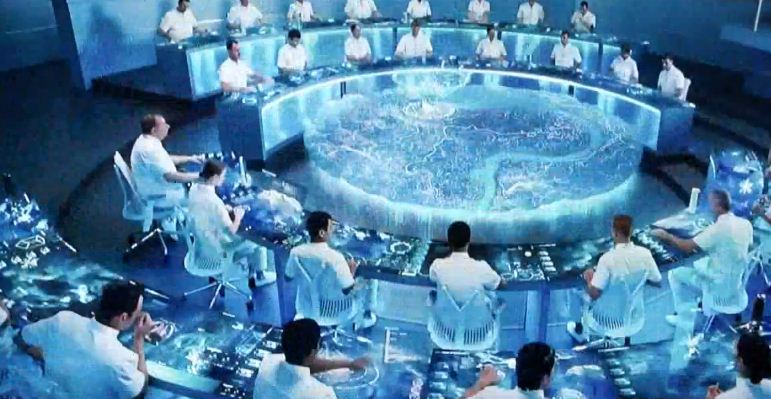
World building.  In the control center, engineers and operators created trees, rivers, fires, storms, and creatures.  What they designed with their virtual reality CAD systems came into very non-virtual being.  It was window dressing to me until he mentioned it, just part of the well-crafted world the story moved through, but it was a detail that captivated his imagination.  Beyond Legos, Minecraft, and even free-wheeling imagination in our backyard.

I wonder how much thought Ms. Collins put into that particular aspect of her tale.  I wonder how many other people were distracted from the carnage by the limitless technology.  When I was his age I had a game for the Commodore 64 called "Raid on Bungling Bay."  It remains one of my all-time favorite games ever.  I played it all the time -- flying my helicopter around the world of islands playing tag with the enemy.  Years later I read an article about the man who wrote it (remember those days?  A single designer/programmer?) and he was talking about his inspiration for the huge hit, "Sim City."

Apparently he wrote a utility to help him build the world of RoBB and it was so much fun to use that he made that utility into its own game - SC.  The world of Panem would be much better if the government turned the arena control center into its own game too.  Not as exciting to read about/watch, but a much better place to live.

Tuesday, December 24, 2013

"Welcome to Pi's Ark."

We're the sort of people who celebrate a religious holiday by exchanging gifts.  Since we don't live where we're from, there is usually a lot of travel and shipping involved in our annual exchange which resulted, this year, in us opening a few gifts a couple of days ago.  A most wonderful thing happened.

#3 opened a package.  (It may as well have been a McGuffin, the item itself is meaningless to the story.)  He really gets into the opening packages bit.  It's a contagious excitement.  Anyway, he opened the package with the aforementioned excitement and turned to #4, practically jumping, and said, "Look what we got!"

It wasn't addressed to them both, just to him.  But he never gave that a thought.  My wife has done an amazing job with all of our children and I've grown used to that.  Seeing and hearing that, though, really struck me.  Wow.  It also made me feel a little guilty for hiding the apple pie.

But not much.

We all need to share -- appropriately -- to stay productive.  If you have knowledge I need to become a better writer then you need to share it with me or I won't get any better (thanks, Dad).  Find some friends that know a bit about what you're doing -- either topically or vocationally -- and get their feedback.  And make sure it isn't all just one way.  You may not be the greatest editor in the world, but you know what works in a story and, as an author, you can say, "This character was flat.  I never really got to know her or like her."  That's sooooo much more helpful than "I thought this was pretty good."

I've read a couple of books about writing.  Steven King's was the best, but they were all pretty good.  These authors have shared their experience with you.  Take advantage of that.  But then also remember, just because you haven't made millions of dollars with your words doesn't mean you can't offer something to those around you.  Just remember it's give and take, not just take, and that the give part comes first.

Sharing is a lifestyle, not a costume.  Nobody is fooled by Batman on October 31st.  But when #3 showed his little brother what they'd gotten?  That was real.  Real builds relationships.  And that's the bit of experience I wanted to share with you today.

BTW - I'm telling you where the pie is.

Tuesday, December 17, 2013

"But, the thing is that you cannot improvise unless you know exactly what you're doing."

I've read quite a lot about how you have to learn the rules before you're allowed to break any of them (in writing).  The axiom is oft repeated but there is never a clear reason given.  I'm not sure if it is something that you have to discover for yourself or if the people who write it believe the truth to be obvious.

I have learned, over the past months that knowing the rules and following them push the mechanics of storytelling to the background allowing the tale itself to come front and center.  The reason is quite simple -- mistakes are distracting and obfuscate the path of the narrative.  Bad grammar is bad style and terribly unprofessional in the workplace.

Consider my favorite sentence from 8th grade.  Teh bOY het an balle.  English teachers say, "What?"  You can figure it out, but it takes a lot of work and by the time you get to the end, you forgot where you started.  The boy hit a ball.  Much clearer.  Boring, perhaps, but clear.

Once you've got the rules down (I highly recommend this blog: Daily Writing Tips) so that every time you write anything it comes out grammatically perfect -- except the verbs, those can't all be perfect -- you can work on the depth of the story.  As you do that, a funny thing happens.  You get into a rhythm and realize that the only way to make a certain point or describe a feeling is by mashing up the usual writing a little bit.  But we're creatures of habit, so when we do that, it's consistent.  Whoah.

We learn to break (bend?) the rules in certain places and ways in a consistent manner to better tell our stories.  That's our voice.  Bad grammar isn't voice, that's just random distraction.  But applied to the right place at the right time... Elmore Leonard, Stieg Larsson, Dick Francis.

Today's title is a quote from this man.


Imagine your 8th grade English teacher reading that sentence.  “The boy hit a ball.”  Now imagine Christopher Walken reading it.  "The boy -- we don't know what boy, but he’s there -- wherever there is because apparently we don't know that either -- but anyways, that boy hit.  A ball.  Some kind of ball.  If he was in Brazil, it would probably be a -- a soccer ball.  But in Jersey, it could be anything.  That boy."

Tuesday, December 10, 2013

The Table-Read: Not just another day in the office

Another snow day today.  And this time I have one too.  Remarkable.  I celebrated this morning by pretending that my couch was a seat on the train and hammered out about 1k words on the novel.  I also did a little bit of laundry just so I wouldn't feel guilty.  That put me behind so no breakfast until I finish this post!

The kids are excited (the ones that are awake) but disappointed that the snow that caused all of this rescheduling is falling as rain.  They're taking it though.  #4 was intrigued by the fact that he's now had  a 5 day weekend.

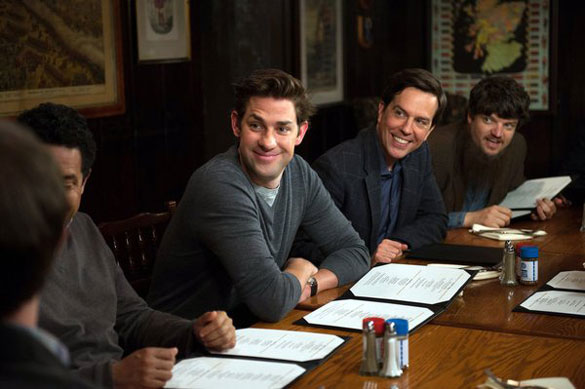
Today's Tool of the Trade is a table reading.  I alluded to its importance yesterday but thought it deserved its own post.  Table readings are incredibly valuable to the writer of stories that will be performed (stage or screen).


First and foremost, the reading gives you another set of eyes on the script.  All those times you typed 'buy' instead of 'but' or 'you' instead of 'your' really stand out when someone else reads them.  I make it a practice to proof-read out loud, but I still miss things.  Prior to submitting "Princess Rose" to the Bluecat competition, I had read it aloud several times but still caught errors when I sat through a reading by Final Draft.  FYI - the final draft tool is helpful but if it had been a feature length script I'd have torn my hair out.  Table reading is much, much better.

The next great thing is that you get to hear how the dialogue actually sounds.  What looks great on the page might be terribly stiff when spoken.  You'll see just how well it all goes together and, if someone has a soliloquy -- or screed -- you'll see that at once.

Then there's getting to hear the interpretation of the actors.  Someone else, someone who doesn't know the story in your head, is speaking the words and the tone will be different.  You may find that more direction is necessary to preserve the feeling of the scene, or that you were going in the wrong direction and should change it because the actor's take was complete genius.    Or maybe everything is perfect.  Lucky dog.

Table readings are also a great opportunity to socialize with folks, to share your lonely occupation with comrades and, if you're wired into the right community, find other film or theater buffs that will remember your work, and you, and involve you in other projects.  Cheetos and leads?  What's better than that?

The last bit about the table read is that you get to see how other people respond to your story.  You see what they like, what makes them emotional, what resonates with them, what makes them yawn...  All very important things for your rewrite.

I've read several great articles online about arranging a table reading.  I didn't follow any of the advice but I didn't have to in this particular situation.  I will, however, be following it in the future.  You know, when I finish my next screenplay and want to know what needs to be fixed.

Tuesday, December 3, 2013

"It is by will alone I set my mind in motion."

I ate too much pie.  Or drank too much eggnog.  Or something.  It had only been a week since I last put on a suit but for some reason, yesterday, it was way, way too tight.  I swung some kettle bells last night, didn’t eat a bag of chips before bed, and today I’m a bit more comfortable.  It looks like I’ll have to plan my cookie binges carefully this month.
Speaking of plans, you should have one.  (Smooth transition there.  Kenny G. better watch out.)  A plan is different from a goal in the same way that a map is different from a destination.  I’ve just finished Nano and had a plan to get that done, but that’s not the whole plan.

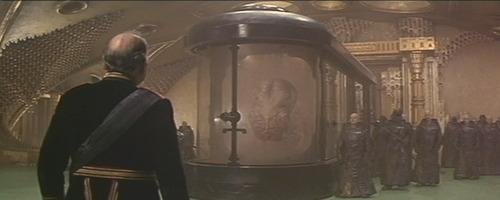
In the movie “Dune” there is a scene in which they talk about “plans within plans.”  That was a weird part of the film, but the concept is really very good.  You have a plan to get a specific task done, but that task is part of a larger plan.  The task (or goal) is not the end.  It may seem that you’re setting yourself up to never be done, but that’s not the case.  You’re setting yourself up to never be lost, without course or purpose.
I had a plan to get the job I have now.  Once I reached that I began working on where I wanted to be assigned, and then what sort of work I wanted to do.  I’m still working on “that next step” because I’m still employed, but now I’m also looking at what I want to do when I retire.  That’s why I blog.  It’s why I am writing so seriously.  I plan to write.  The closer I get to retiring, the more detail I have to have in that plan.  Sure I want to write, but what does that mean and how do I get there?
One of the tasks I have in that plan is to publish a novel before retirement.  That task requires its own plan.  A plan that included Nano but goes far beyond simply writing that many words in a month.  Nano was just a task in the plan to publish.
Looking at it this way helped me through Nano because even if I didn’t win, I was still working toward my publishing goal and I knew exactly where that fit in my vocational goal.  Recognizing that each page I wrote was a step closer to achieving the big, pie in the sky, goal helped me resist the urge to “take a break from the silly contest and play Plants v. Zombies.”
Now that Nano is done I can appreciate the accomplishment, and I am personally proud of making it – I had to overcome a few challenges to get there – but my work is only half finished on this story.  I need another 50k words before I can start the 2nd draft.  That doesn’t seem insurmountable.  I just hammered out 50k in a month.  (See yesterday’s post about proving to yourself you can do something…)
After the 2nd draft I’ll need readers that will give me high quality feedback – the sort of feedback that hurts.  As I write now, I know that some of what I’m wracking my brain over will be cast aside.  It can seem depressing, but in the overall scheme, it’s about making the work the best it can be.  With that as the plan, slogging along the path to get there isn’t so bad.
It’s sort of like driving in traffic.  Sometimes you want to just pull over and quit.  But you don’t.  If you did that you’d never get where you were going.  Are you playing Frisbee at the rest stop or staying in your lane ticking the miles off one by one?

Tuesday, November 26, 2013

Nobody got time for that.

Today's tool of the trade is prioritization.  Instead of writing some clever insight or pithy rant, I'm going to demonstrate it.  I'm in the final week of nanowrimo and have 13k words to go.  I can do it, if I buckle down.  I plan to do it.  I've come to far to not make it.  But I can't do that and everything else.  My family is a bigger priority so I won't steal their time.  My job is a bigger priority (can't buy groceries with a nano badge) so I won't shirk my duty.  But the blog?  Well, I love writing the blog but it's a few hundred words I could add to my nano total coming in on the train.  Through the sleet and snow.

**update.  I was able to knock out 1200 words this morning.  Thank you for your understanding.

Tuesday, November 19, 2013

"That's not fair."

Last night #4 heard a suggestion that it was about time to brush his teeth and get ready for bed.  Since it wasn't a direct command, he decided to disappear into the laundry room.  Not to do laundry, mind you, but to prepare an act for us.

He came out with his PJ bottoms rolled up into shorts and the waistband about four inches above his belly button.  He danced around a bit humming a song that I recognized more my context than his rendition, and said, "Who am I?"

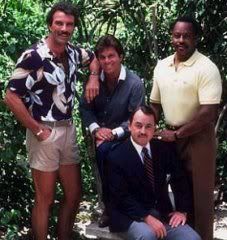
My wife wasn't sure so he said, "Come on, Higgy-baby, who am I?"  I helped by joining in on his song.  She guessed at once and started laughing hysterically.  The night before we'd watched an episode of Magnum PI and she had commented on his shorts.  My daughter, flabbergasted, said, "You're only just noticing them now?  They're awful.  They’re always awful."

I thought that was a bit harsh, but the shorts were pretty funny looking.  And #4's interpretive dance lampooned them perfectly.

Which brings me to this week's tool of the trade - Voice.

Voice is your specific style, the way you communicate your unique vision.  Without voice you're just part of the crowd, a cheap knock-off.  With strong voice you not only stand out but are immediately recognized.  If #4 had just put on a pair of goofy shorts and asked, "Who am I?" he would have just looked like a Magnum wannabe and we wouldn’t have thought it was funny, but by being himself and clowning it up, his brought his own style.  It was fresh and fun.

I do a lot of writing for my job and in previous years that included ghost writing for my superiors.  The first time I was asked to write something for my boss to distribute was about 5 years ago and he came to me with my wonderful memo and said, "Jon, this is great but I'd never say it this well."  He was a very good boss.  Told me I'd failed at the assignment but was a good person in that one sentence.  I was immediately hooked on the challenge of writing like someone else.

In my "hey-day" I was writing in 4 distinct alternate voices - three senior managers and something boring I'll call "generic office."  It was really interesting work and I got very good at it.  But there's a world of difference between emulating someone else's style and having your own style.

You will absorb things into your writing style from others -- maybe sentence structure, or specific vocabulary and that's good.  Musicians do that all of the time - Heart was heavily influenced by Led Zeppelin and if you listen carefully you can hear that.  But Heart wasn't a Led Zeppelin cover band.  When you write, you shouldn't be indistinguishable from P.D. James even if she has influenced you.

To develop your own voice you need to read a lot, from different authors and genres, and write a lot, preferably on different topics and from different points of view.  These two things will expose you to a multitude of style choices and provide ample opportunity for you to practice putting your ideas to paper in a way that is instantly recognizable.

It also helps if you untuck your shirt when wearing shorts that hug your ribcage.

Tuesday, November 12, 2013

"Why didn't you answer?"

When Tuesday feels like Monday it's hard to keep the schedule straight.  Not that I'm complaining, I've been fortunate enough to have many, many years of employment during which Tuesdays that feel like Mondays mean a four day work week and, dedicated civil servant or not, I like days off.  (No sarcasm.)

I had the refreshing experience of being stuck on the wrong side of the tracks this morning.  (Dripping with sarcasm.)  A mile or two of passing freight train blocked the road while the commuter pulled in, boarded, and departed.  If it weren't for the biting wind I probably wouldn't have complained.  After all, the train is only taking me to a place where everyone wants something.  At my cafe table there are no such demands.  Just a blank page that needs to be filled.
  

I don't have any high heeled shoes.  Not a single pair.  That shouldn't surprise you.  If you know me you'd probably think the idea of me wearing high heels is pretty silly.  I absolutely agree.  It isn't that I have anything against them but they aren't something I need (which is why I don’t have them).  Why in the world would I spend time shopping for, and then money to buy, something I have no need for?  My height/weight ratio is one that I'm comfortable with.

As a writer subscribed to blog feeds from business which sell writing products, I'm always receiving email notices and alerts to buy stuff.  Stuff that promises to make my writing easier and better.  I buy very, very little of it (Storyist, Final Draft, and... guess that's it).  Why?  Because I don't need any of it.  I have been attracted to the shiny packages and thought, "Wow, that looks nifty" a few times, but in the end I haven't bought anything because it really doesn't do anything to help me.

It might for you - but make sure it does using the free trial versions before you buy it.  Too many of the products aren't really making your writing easier, they are just making it electronic.  Like "Save the Cat."  It's a really neat little program that works well and duplicates, electronically, the notecard system that the books promote.  Thing is, it DUPLICATES something I already use and as fun as it is to play around with, it doesn't help my writing at all.  It's a distraction and sucks time away from writing because I have to figure out how to use it.  I have to configure reports.  I have to transfer into other programs.  I have to print things out so I can I take them with me -- essentially creating a paper product that duplicates my paper system.  It will even print directly to index cards for me.  That's a wonderful feature because index cards are wonderfully useful.  I know this because I already write onto index cards...  See where I'm going?

For some people, and I believe this, the computer application increases productivity.  But not for me.  As much as I wanted to buy it because of the gee-whiz factor, it would keep me from writing rather than increase productivity.  Writing isn't like hunting where there are only certain times you can be out doing it and when you can't, browsing catalogues and reading magazine articles lets you dream about the next time in the woods.  Writing is something that can be done anytime you are at the keyboard and when you're playing with a shiny new piece of software you are not writing.

Don't be the sort of writer who isn't writing.  Don't be the starving artist that spends grocery money on something you don't need.  If you don’t need the tool to do a specific task right now, you don’t need the tool.